Works by Peter Paul Rubens
535 works · 217 ms
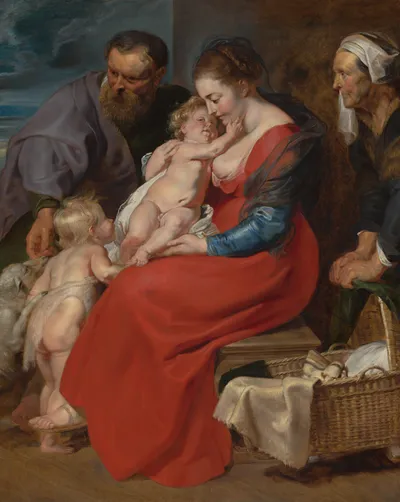
Peter Paul Rubens packed his altarpieces and myths with muscular bodies that twist, reach and grapple, and his big Antwerp workshop painted many pictures from his own drawings and oil sketches.
In 1600 Rubens went to Italy; in Venice, his first stop, he saw paintings by Titian, Tintoretto and Veronese, and for most of the next eight years he worked for the Duke of Mantua. The Fall of Phaeton, begun about 1604–05 and probably reworked later, throws Phaeton headfirst from a gold chariot as a shaft of sunlight cuts through rearing white horses and women with butterfly wings. A few of the red reins stop short in mid-air or show as dark lines under the paint. In Genoa he painted portraits such as Marchesa Brigida Spinola Doria of 1606, in white satin that shines in long folds, her face set in a lace ruff as wide as her shoulders.
Back in Antwerp he became court painter to Archduke Albert and the Infanta Isabella in 1609, but was allowed to keep working in his own city. His workshop, in a house and studio he designed himself, turned out three kinds of picture: ones he painted alone, ones where he did chiefly the hands and faces, and copies made under his eye from his drawings or oil sketches. Animals, landscapes and still lifes often went to specialists such as Frans Snyders. His own chalk Lion of about 1612–13 crowds the sheet so closely that its paws are cut off at the bottom, and it frowns out from under a heavy mane.
Charles I, who knighted him in 1630, later had him decorate the Whitehall Banqueting House ceiling. Peace Embracing Plenty, an oil sketch on panel from 1633–34 made to guide the studio, has Peace in gold bending over Plenty in pink, with a horn of fruit between them and twisted columns laid in with quick brown strokes. In 1630 he also married the sixteen-year-old Helena Fourment, whose full figure comes back in his late myths: in The Feast of Venus couples dance at the left while winged children tumble through the trees with garlands around a pale statue of the goddess. Religious and mythological scenes in warm browns, painted between the 1610s and the 1630s, make up most of what follows, along with portraits, several self-portraits and a few drawings.
Sources: Wikidata, Wikipedia, National Gallery of Art, Kunsthistorisches Museum, Yale Center for British Art.